RZ
Live orchestration

Agents laboratory

Nova: an army of autonomous agents with a CEO, divisions and specialists. See how real work is orchestrated 24/7 — not a chatbot, but an operable system with traces, cost and roles.

What it solves

From manual ops load to a governed agent network

The lab focuses on one system: Nova, autonomous agent orchestration. No CRM, landings or commerce panels mixed in — only the agentic layer that coordinates real work.

The problem

Senior teams burn hours on research, content, follow-up and repetitive ops. A lone chatbot does not assign ownership or leave auditable traces. You need a network with clear roles, explicit routing and a human operator who can see state without opening ten tools.
How it applies

Nova organizes a CEO, division hubs and specialists (CrewAI + FastAPI). The operator launches work from /visual and /vivo panels, tunes prompts/models/tools per agent without redeploy, and connects MCP/Composio/MWS tools when the task needs real action — not just text. Inference can stay on Ollama (local-first) or scale to cloud providers by cost and risk.

What this section validates

That you can design multi-agent orchestration as an operable product: role graph, profile catalog, observability, domain RAG and FinOps. It serves interviews and technical buyers who want agentic architecture evidence — not generic 'AI' slides.

Top capabilities

What makes this orchestration different

Routing by specialty

29+ specialists under a CEO and hubs: research, content, ops. Each role has ownership; the system does not dilute everything into a single assistant.

Observability and traces

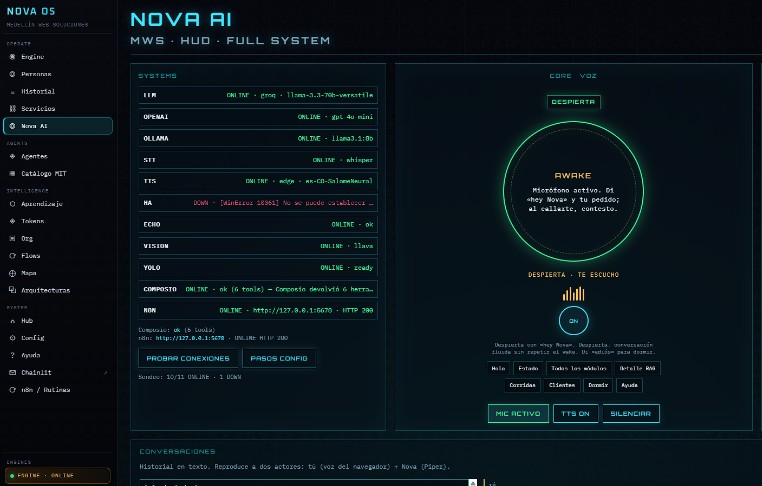
Live timeline, SSE (/vivo) and subsystem HUD. If a module drops or a run fails, you see it — it is not hidden behind a chat.

Config without redeploy

Prompts, models and tools per agent from a panel. Operate the network as a product, not as a repo you redeploy for every tweak.

MIT role catalog

Open-source profiles mapped to the Nova org chart: speed up capability design without inventing opaque taxonomies.

Domain RAG + FinOps

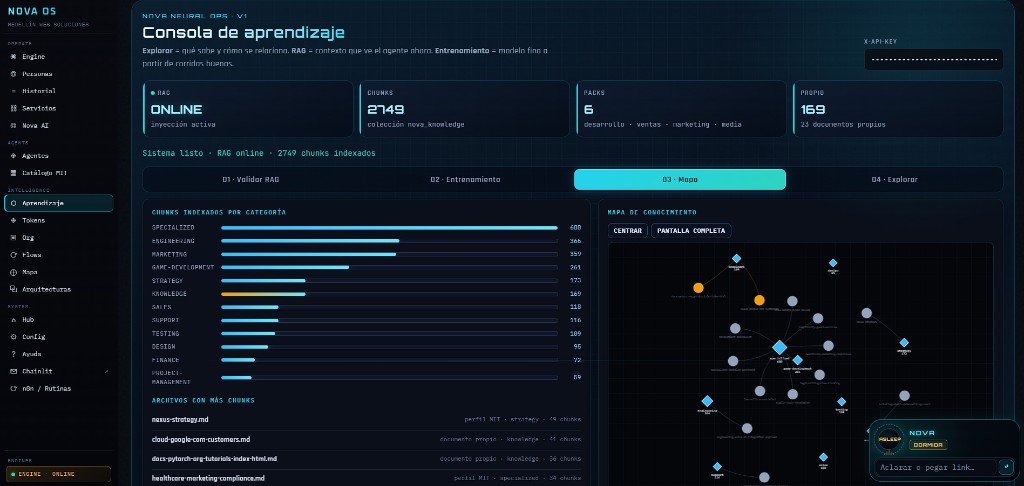
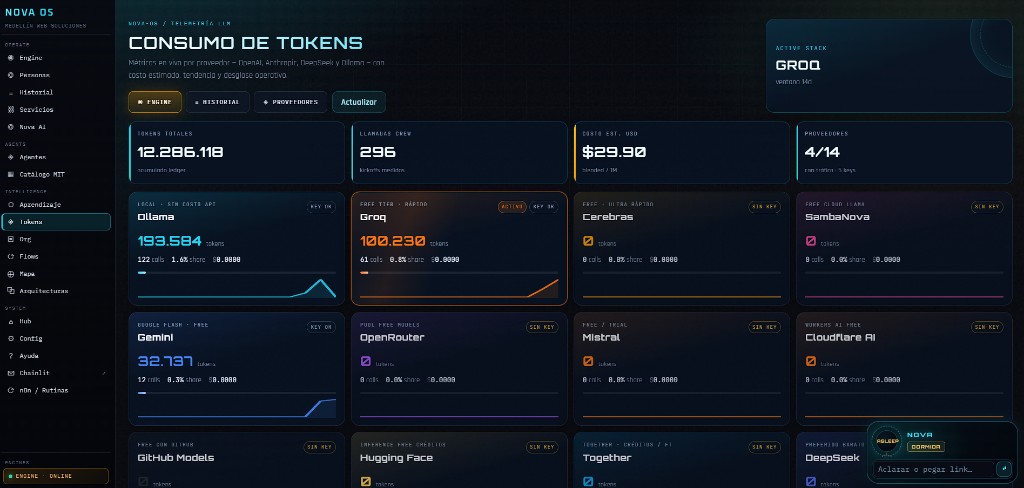
Indexed business knowledge and a provider cascade with visible cost. Orchestration decides where each task runs.

Local-first with controlled escapes

Ollama inside the perimeter when privacy matters; external tools only when the work requires it. Explicit trade-off, not magic.

Screenshots and videos of Nova running for real. Audio is not required to understand the content.
Orchestration surfaces

Nova operational gallery

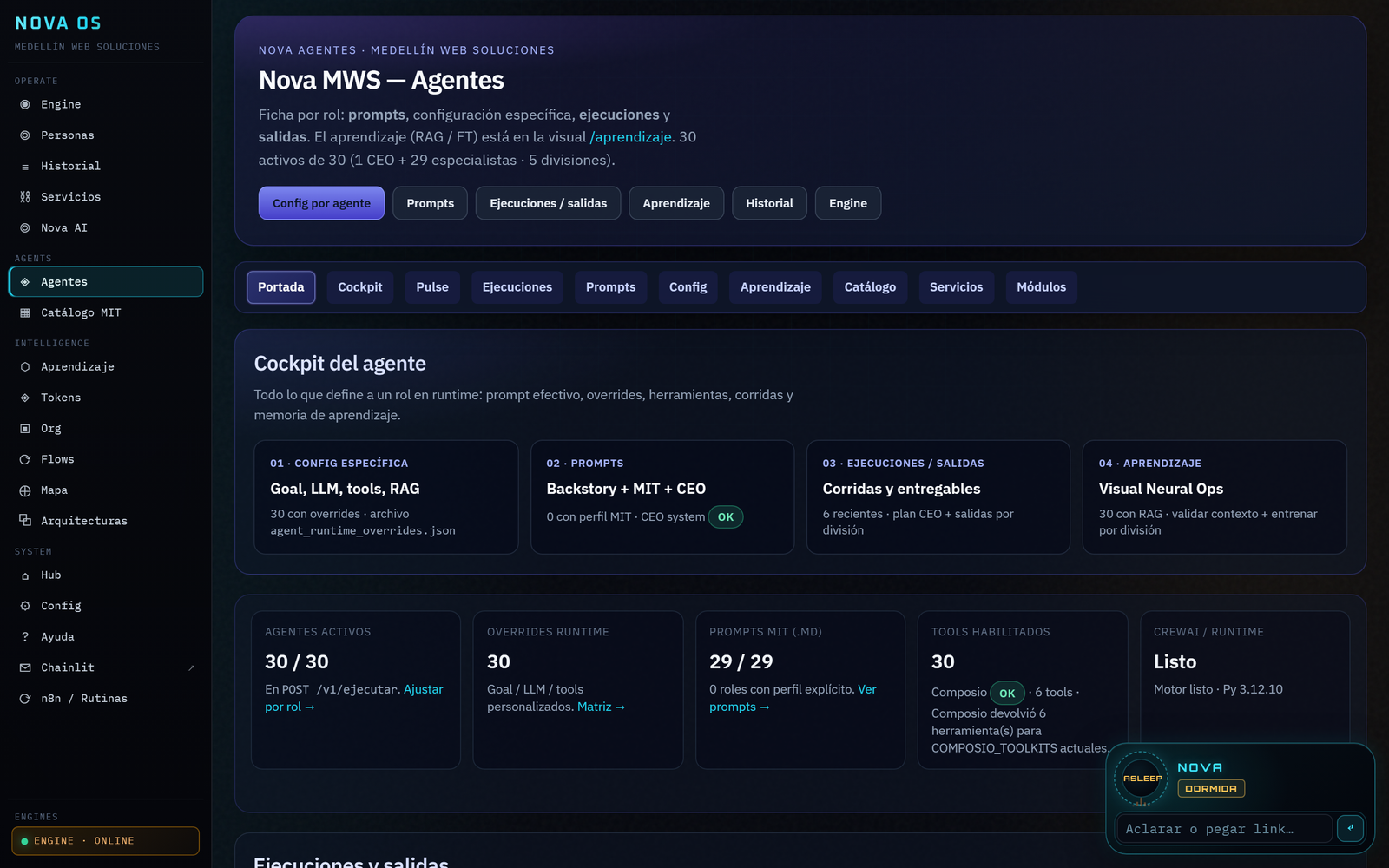
Walk the role graph, MIT catalog, per-agent config, health HUD, RAG and FinOps. Each slide is a layer of the same orchestration system.

CrewAIFastAPI3D graph

Engine — live orchestration

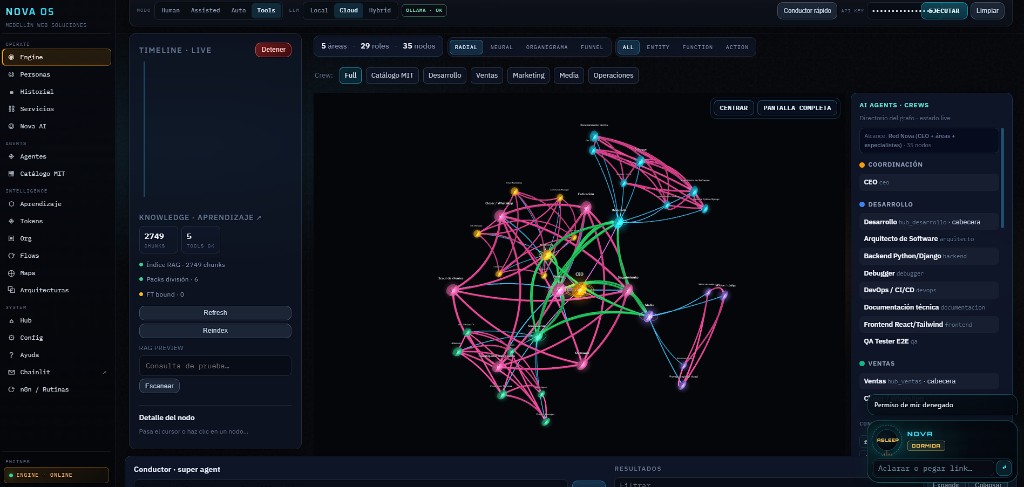
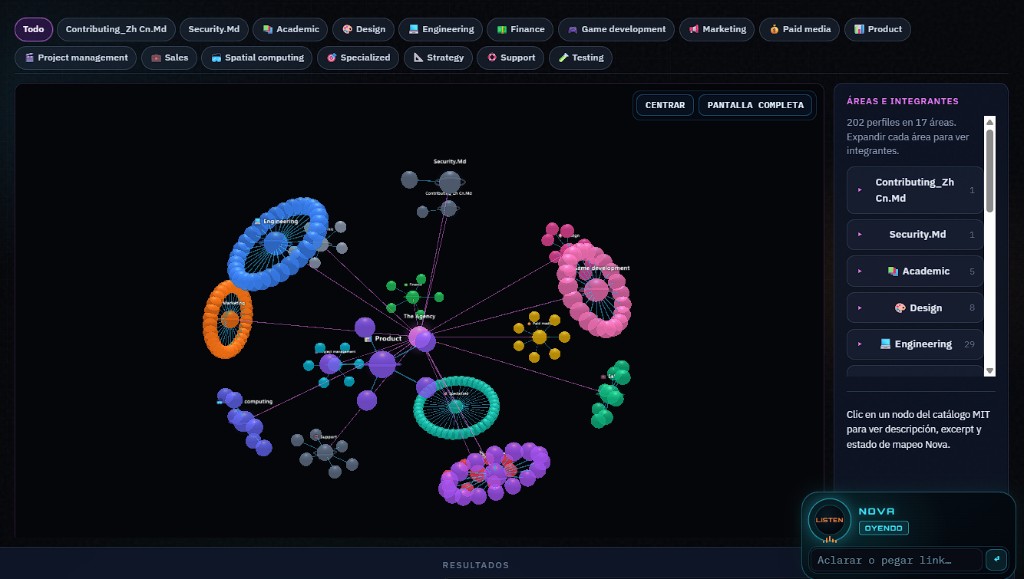
Nova agency graph: 5 areas, 29 roles and 35 nodes. Execution timeline on the left; crew directory on the right. Every node is a specialist with its own config — orchestration is visible and operable, not imagined.

Live execution

How the agent network moves

Short clips of orchestration, multi-agent collaboration and Nova panels. Proof the system is not a diagram: it runs, routes and leaves evidence.

AI agentsCrewAINova

AI agents executing

Ecosystem of autonomous agents running tasks in real time: each takes a role and collaborates in the flow orchestrated by Nova.

  • Live multi-agent coordination.
  • Continuous execution with traceability.
OrchestrationMulti-agentMCP

A network of agents collaborating

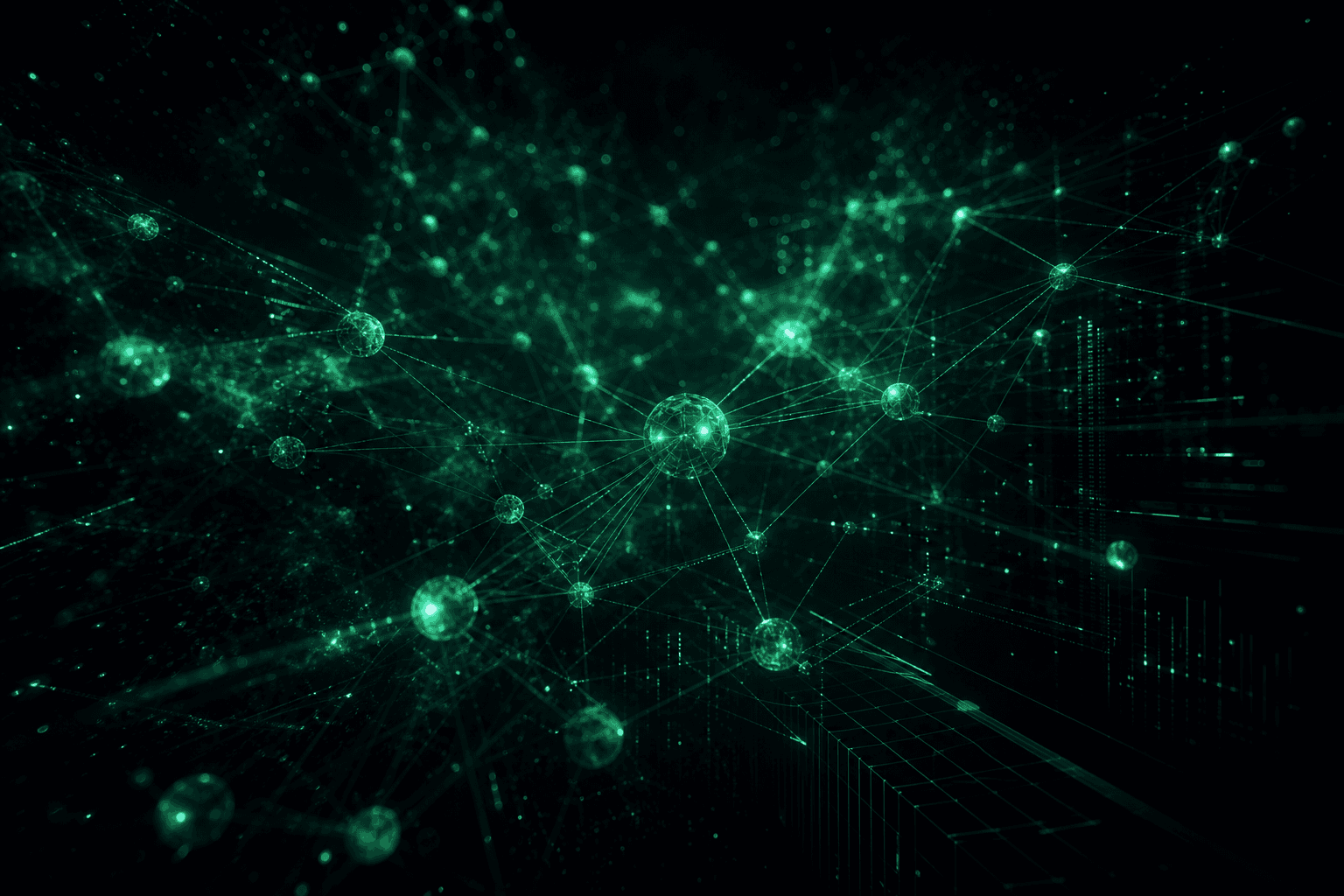
Topology of an agent network: communication, work split and convergence to a useful result under a CEO and division hubs.

NovaFastAPI3D graph

Nova — visual panel

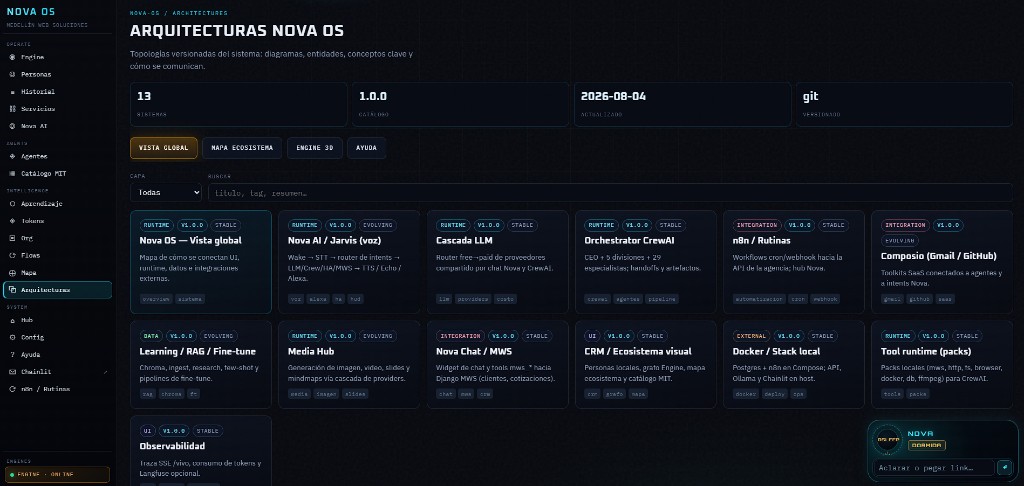
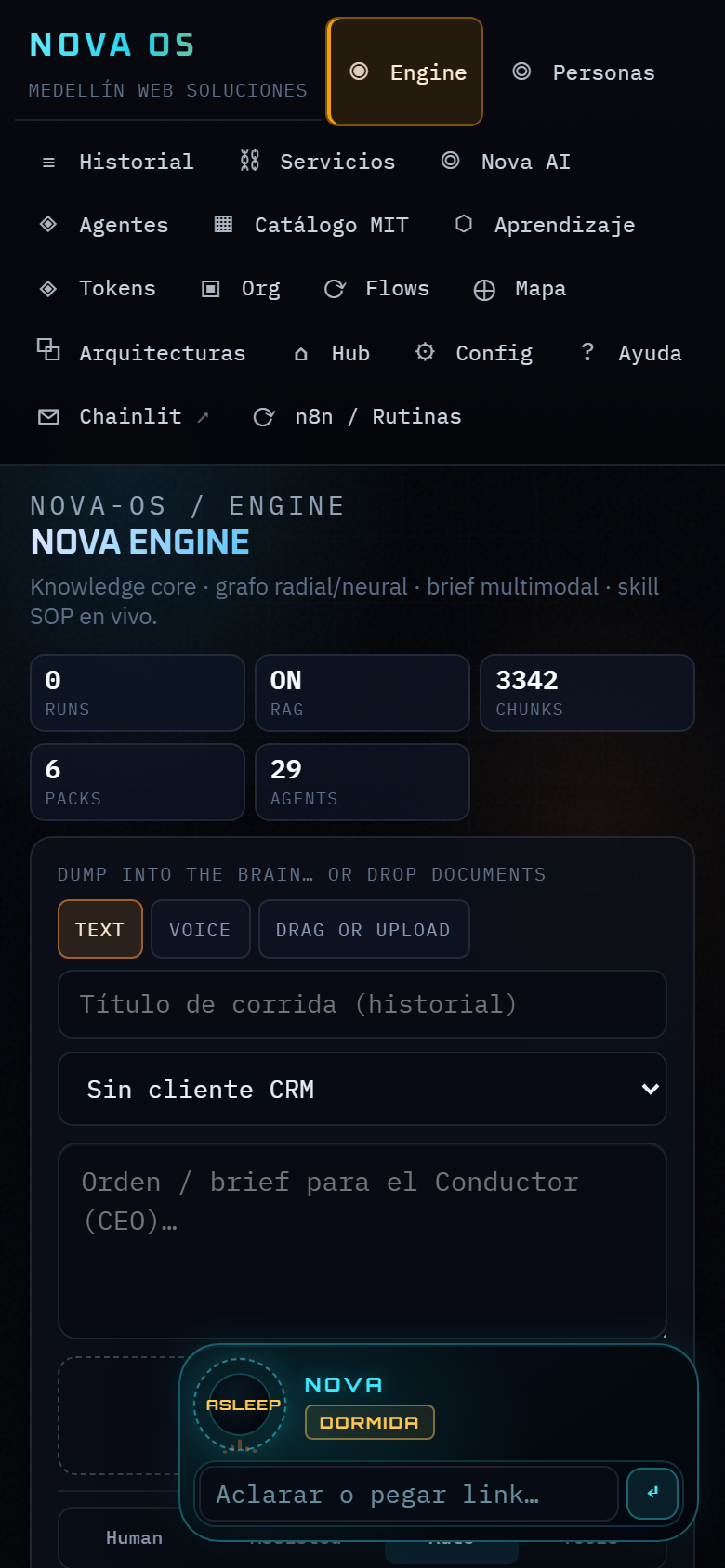
Nova's operational architecture: CEO, divisions and 29 specialists as a system—not a demo.

MITRolesCatalog

Nova — MIT role catalog

Walkthrough of the agency-agents catalog (MIT license) mapped to Nova roles: 200+ profiles to decide which specialist handles each task.